
None of the four benchmarks suggested by the RBI is ideal as banks in India create loan assets from their deposits and not borrowing from the regulator or market, says Tamal Bandyopadhyay.

'When I came here in 2002, I said you can grow at 8%.' 'And I was told that was crazy, and (now) here we are.'

In 2022, gold emerged as the top performer among all conventional asset classes with over 14 per cent returns mainly owing to the depreciation of the rupee.

The Enforcement Directorate (ED) on Friday said it has issued show-cause notices to the Indian arm of Chinese mobile phone manufacturer Xiaomi, its chief financial officer and director Sameer B Rao, former managing director Manu Kumar Jain and three foreign banks for alleged violations of the foreign exchange law to the tune of more than Rs 5,551 crore.

If you don't have a specific goal, but want intermittent liquidity, then ladder your FDs, that is, invest in FDs of varying maturities, such as one, two, three, five or even 10 years. Laddering ensures FDs mature at regular intervals.

Loan against gold as a product is catching on fast. Let's keep the momentum going, but aim for sustainable growth. A few bad apples should not ruin the brunch, argues Tamal Bandyopadhyay.

Information technology (IT) companies have been on the road to revival in the past one year. From being the worst-hit sector in 2022 with a loss of 26 per cent, the Nifty IT index closed 2023 with gains of 24 per cent. So far in 2024, the index is up around 7 per cent against the nearly flat Nifty 50 benchmark index. The IT index has been on a continuous decline in the last three sessions.

Soon after the lifting of the 13-day moratorium at 6 pm, some customers took to social media complaining that they were not able to access certain services, including internet and mobile banking.

Kotak Mahindra Bank was the biggest loser from the Sensex pack, skidding 1.83 per cent, followed by Axis Bank, NTPC, Hindustan Unilever, ICICI Bank, Bharti Airtel, Reliance Industries, HCL Technologies, IndusInd Bank and Nestle. In contrast, Bajaj Finance, Bajaj Finserv, Tech Mahindra, Tata Consultancy Services, Titan, Infosys, HDFC Bank, HDFC and ITC were the gainers.

Traders suspect The Reserve Bank of India (RBI) bought bonds and actively intervened in the rupee to support sentiment.

Investors with high risk appetite must stay invested while risk-averse investors can consider profit booking.
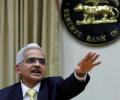
The MPC headed by RBI Governor Shaktikanta Das will announce the resolution of the meeting at around noon on Thursday.
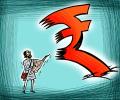
Indian rupee, which earlier this week touched an all-time low, is likely to remain under pressure and may test new levels as a fallout of the US Federal Reserve indicating more interest rate hikes, experts said. The aggressive rate hikes will dampen demand and increase the possibility of a recession in the US. This could accelerate the pace of capital outflows, weaken the rupee and raise the threat of imported inflation.

Benchmark indices continued their downtrend for the fifth session on the trot on Thursday, with the Sensex tumbling nearly 817 points in early trade, tracking weak global trends and selling in index majors Reliance Industries and HDFC Bank. Unabated selling by foreign institutional investors also weighed on the sentiment. The 30-share BSE Sensex was trading 816.78 points lower at 53,271.61. The NSE Nifty declined 234.05 points to 15,933.05.
.jpg)
The rupee is set to breach the Rs 60-a-dollar mark again this week as the Street expects foreign institutional investors to continue pulling out of domestic markets. According to the street, this would result in government bond yields rising.

Winding down quantitative easing will be messy for the West and a big problem for India.


'While Indian markets are indeed not inexpensive, the valuations of largecap stocks are still a considerable distance from being overstretched.'
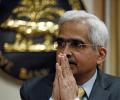
'Three external members of the first MPC are respected researchers with excellent academic background, but there is no harm in considering academicians with diverse backgrounds such as finance and labour along with economists for this body,' recommends Tamal Bandyopadhyay.
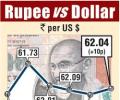
The currency's relatively stable performance even as the US announced tapering showed India's better preparedness to deal with any fallout of such foreign fund outflows.

ICICI Bank, HUL, HDFC Bank, M&M, Ultra Cement, IndusInd Bank and Tech Mahindra were among the losers in the Sensex pack. NSE Nifty slipped 13.95 points to 17,355.30.

'India is not so distant from years of high and entrenched inflationary expectations that it should start trying to play games with the economy the way the West's central bankers think they are entitled to,' argues Mihir S Sharma.

Foreign Portfolio Investors' (FPIs) selling spree continues as they pulled out over Rs 3,400 crore from the Indian equity markets in the first three trading sessions of November on rising interest rates and geopolitical tensions in the Middle East. This came after such investors withdrew Rs 24,548 crore in October and Rs 14,767 crore in September, data with the depositories showed. Before the outflow, FPIs were incessantly buying Indian equities in the last six months from March to August and brought in Rs 1.74 lakh crore during the period.

Banks will also consider requests from MSMEs for restructuring their stressed standard assets. So far, only 25 per cent of the around 1 million eligible MSMEs have taken benefit of the RBI's special dispensation.

Equity markets rallied after softer-than-expected inflation data in the US and UK rekindled hopes of the end of the rate-hiking cycle by major central banks. The soft inflation reading drove down bond yields and the US dollar, whetting the appetite for risky assets. The 10-year US bond yield fell below 4.5 per cent after topping 5 per cent less than a month ago.

A 2008-style bank run seems unlikely, but if it did happen, the sector is much better prepared.

Banking shares are down up to 11% after the Reserve Bank of India has increased the policy repo rate by 25 basis points from 7.25% to 7.5% with immediate effect.
Yes Bank was the biggest gainer in the Sensex pack, rallying 10.94 per cent. Other gainers included Sun Pharma, IndusInd Bank, L&T, ICICI Bank, Maruti, Bajaj Auto, Tata Motors and ONGC, rallying up to 4.01 per cent.

India needs to move towards full capital account convertibility to become a leading global economy.

Equity markets will be driven by the outcome of the US Federal Reserve's interest rate decision this week, analysts said. Moreover, equity benchmarks will also continue to be guided by foreign fund movement and trend in Brent crude oil, they added. "The global markets are looking nervous after the US inflation numbers, which have caused the dollar index to hover around 110," said Santosh Meena, head of research, Swastika Investmart Ltd. Now everyone is eyeing the outcome of the upcoming US Federal Open Market Committee (FOMC) meeting.

'It makes sense to have gold in one's portfolio keeping the political and economic risks of 2024 in mind.'

From the Sensex pack, State Bank of India, ICICI Bank, IndusInd Bank, Axis Bank, Kotak Mahindra Bank, HDFC Bank, Reliance Industries were among the major laggards. Bucking the trend, auto stocks Tata Motors and Mahindra & Mahindra closed with gains.

Observing that US' economic recovery is proceeding at a moderate pace, US Federal Reserve Board chairman Ben Bernanke said on Wednesday the central bank might need to intervene if policymakers enact short-term spending cuts that hurt growth.
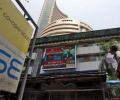
Hero MotoCorp was the top gainer in the Sensex pack, spurting 4.46 per cent. IndusInd Bank, Tata Motors, Vedanta, SBI, M&M, Sun Pharma, Tata Steel, HDFC and HDFC Bank too rose up to 3.63 per cent.

The apex bank also noted that manufacturing activities slowed down in certain parts of the country.

The steep fall in rupee came on a day when the Reserve Bank of India in its first quarter review of monetary policy kept the all key rates unchanged but cut the gross domestic growth forecast to 5.5 per cent for FY'14 from 5.7 per cent earlier.

From the Sensex pack, IndusInd Bank, Mahindra & Mahindra, PowerGrid and Bajaj Finserve gained up to 2.01 per cent. On the other hand, bellwether stocks such as ITC, Kotak Mahindra, Tech Mahindra and Reliance were the laggards. ITC shares closed the session with a loss of 3.87 per cent lower and Reliance ended 1.92 per cent lower.

RBI's interest rate decision, macroeconomic data and global trends would dictate terms in the equity market in a holiday-shortened week, analysts said. Besides, the focus will also be on foreign portfolio investors' trading activity, they added. Equity markets will remain closed on Tuesday for 'Mahavir Jayanti' and on Friday on account of 'Good Friday'.

Equity indices faced a heavy drubbing on Thursday after an initial rally, with Sensex tanking 1,045.60 points amid a largely bearish trend overseas after the US Federal Reserve hiked rates by 75 basis points.

'Recent underperformance notwithstanding, equities should constitute a major part of investors' financial portfolio.'
